

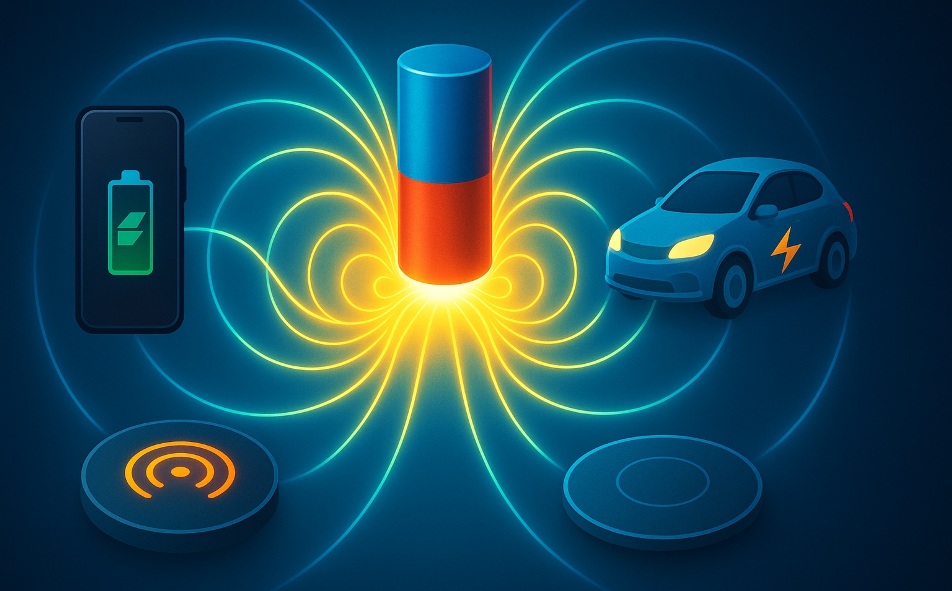
Magnets are the quiet workhorses hidden in our favorite tech. Tiny metal slivers guide a smartphone’s compass, spin an electric car’s wheels, and beam power through the air to charge a smartwatch. This article explores how those invisible fields move electrons, save energy, and make our daily gadgets feel almost magical
The Simple Physics Behind the Magic
Every magnet creates a field. When that field moves near a coil of wire it pushes electrons, making current. The greater the resistance encountered, the more potent the propelling force—a fundamental principle underlying the operation of loudspeakers, electric motors, and wireless charging devices. It all comes from one principle: changing magnetic flux equals electricity.
Magnets Inside Phones
A phone holds more magnets than many realize. A micro‑speaker relies on a tiny coil stuck in a magnetic gap; current through the coil vibrates a thin diaphragm and makes sound. A vibration motor acts the same way but with an off‑center weight, shaking the chassis for alerts. Even the camera’s autofocus ring floats in a magnetic cage so pictures stay crisp.
Smartphones also need orientation. A three‑axis magnetometer senses Earth’s field so maps point north. That sensor uses wafer‑level coils and paired magnets. Without them, your GPS arrow would spin aimlessly.
Phone engineers also use miniature ring magnets to anchor fold‑out accessories such as kick‑stands and selfie grips. The same ring guides the new Qi2 standard, which brings cross‑brand alignment so Android and iPhone pads share parts. Under the glass, a Hall‑effect sensor registers flip‑cover cases and stylus docks, proving that clever field detection can replace bulky mechanical switches, keep bodies sleek, and save extra space.
Apple popularized MagSafe technology, a ring that snaps chargers and cases into perfect alignment. The key lies in a precise, centered magnetic pull on the copper coils; this optimizes efficiency and simplifies charging.
Also Read: NinjaByteZone.com – Tech, Gaming & Digital Trends
Magnets Driving Electric Vehicles
Electric vehicles swap the combustion of gasoline for the rotational power of copper coils and magnets, with permanent magnet motors forming the core of most modern EVs. Here, a rotor lined with powerful alloys turns inside a stator of copper windings. Current in the windings creates a rotating field; the fixed magnets chase that field, producing instant torque and silent acceleration.
Why not use induction motors everywhere? Powerful magnets lead to lighter rotors and smaller batteries, significantly boosting efficiency. Fewer amps lost as heat equals extra range on the highway. Automakers shave grams by shaping magnets, swapping pricey elements, and adding cooling channels so nothing demagnetizes under load.
Magnets and Wireless Charging
Wireless pads feel like sci‑fi, yet the science is textbook. A charger coil feeds alternating current that sets up a changing field. A receiving coil within the device intersects this field, generating current to charge the battery—a process known as wireless power transfer.
Most living‑room pads rely on electromagnetic induction. For more freedom, some chargers use resonant inductive coupling, tuning both coils to the same frequency like twins humming in harmony.
Smartphone makers add small alignment magnets so devices snap into the sweet spot every time. That prevents wasted energy and hot pads. Electric SUVs now park over garage plates that beam kilowatts overnight with no cables to trip on.
Why Material Choice Matters
Not all magnets are equal. Rare earth magnets offer extraordinary strength in a thumb-sized package. The king is neodymium magnets: an alloy of iron, boron, and a pinch of rare metals. Engineers sometimes call the blend neodymium iron boron.
Sintered NdFeB blocks appear across tech. Phone speakers use milligram flakes, while an SUV motor may carry kilos. Cost swings with commodity prices, so companies recycle shavings and old hard drives to keep supply steady.
Future Outlook
Magnetic research never rests. Labs test grain‑boundary tricks to raise heat tolerance. Automakers model skewed rotor designs that use fewer grams yet keep torque high. Inductive roadways under asphalt promise to top up cars while driving, cutting range anxiety.
Conclusion
Magnets turn silent fields into real‑world motion and power. In phones, they shake, speak, and guide maps. In EVs, they swap exhaust fumes for clean acceleration. On charging pads, they erase cords for good.
FAQs
1. Do wireless chargers waste energy?
A good pad aligned by magnets loses only a few percent more than a cable, so users seldom notice.
2. Can strong magnets erase phone data?
Flash memory is not magnetic, but speakers and compasses can misbehave when exposed to extreme fields.
3. Why are EV magnets expensive?
They use scarce elements mined in limited regions, and refining them is complex.
4. Are phone magnets safe for pacemakers?
Small device magnets are weak at a few centimeters, yet doctors advise keeping phones six inches away.
5. Will future cars drop magnets?
Some brands test switched‑reluctance and induction drives, but magnets still offer the best mix of power and efficiency.
