

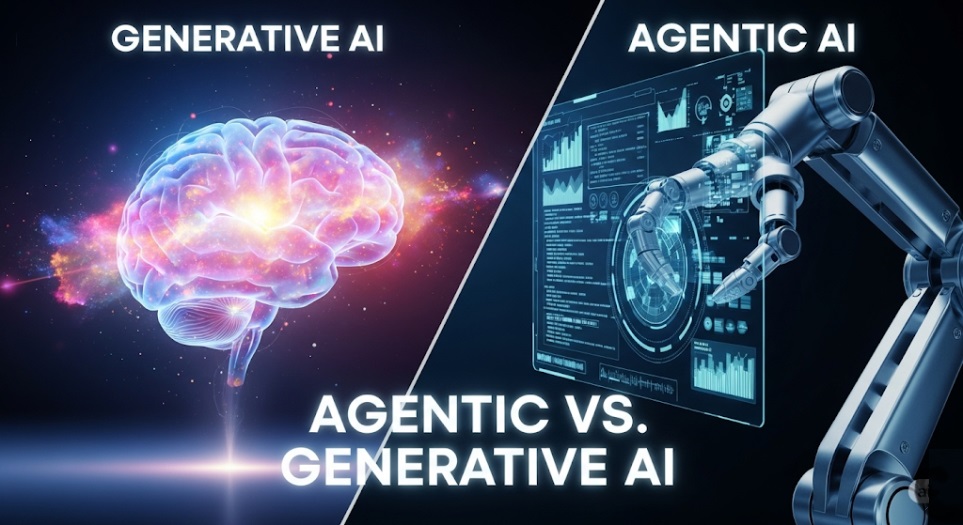
Artificial intelligence continues to reshape our world, empowering everything from chatbots to self-driving cars. Within this vast landscape, two paradigms stand out: Generative AI, celebrated for its creative prowess, and Agentic AI, prized for autonomous decision-making and real-world execution. In this article, we’ll explore how these technologies differ, where they overlap, and why understanding their strengths is crucial for businesses and developers aiming to harness AI from creation to action.
What Is Generative AI?
Generative AI models create original content—such as text, images, music, or code—by learning and applying patterns from pre-existing data. At its core, generative AI answers “What can be created?” by:
- Learning statistical relationships in large datasets
- Sampling from learned distributions to craft original outputs
- Iteratively refining generations based on user prompts
Popular examples include OpenAI’s GPT series for text generation, DALL·E for image synthesis, and deepfake systems that can produce lifelike audio or video. Generative AI excels at ideation, rapid prototyping and personalized content creation, making it indispensable for marketing, design and entertainment.
What Is Agentic AI?
While generative AI focuses on creativity, Agentic AI emphasizes autonomy and goal-oriented action. An agentic system perceives its environment, plans multi-step tasks and adapts its strategy over time. Key characteristics include:
- Perception and Reasoning
Agentic AI systems use sensors or data streams to understand context—whether it’s user behavior, financial market shifts or factory conditions. - Goal-Directed Planning
Given a high-level objective (“optimize delivery routes” or “reduce server downtime”), these agents break down tasks into actionable steps. - Autonomous Execution
They carry out decisions—placing orders, sending alerts, adjusting machinery—often without human intervention.
Examples range from automated trading bots and warehouse robotics to intelligent virtual assistants that autonomously schedule meetings or monitor cybersecurity threats.
Key Differences: Creativity vs. Autonomy
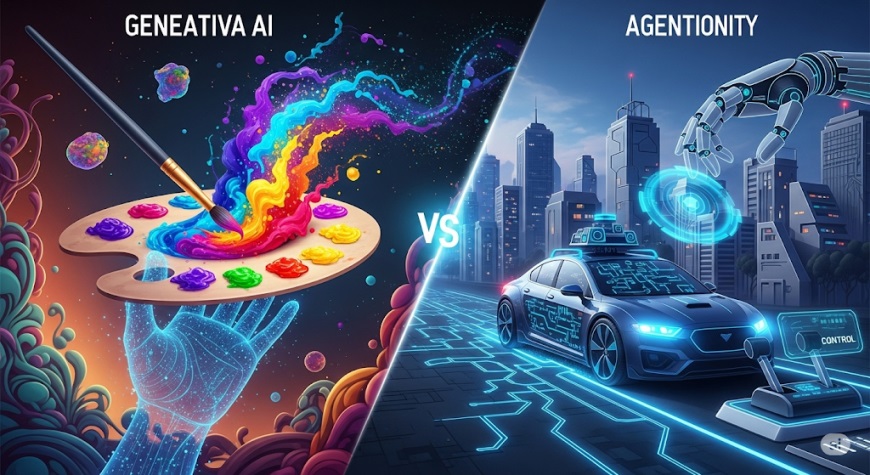
Although both paradigms rely on advanced machine learning, their focus diverges:
Output vs. Outcome
While generative AI creates outputs, agentic AI focuses on achieving specific, quantifiable outcomes. For instance, a generative model can draft an email, whereas an agentic assistant sends follow-ups, coordinates calendars and tracks responses.
One-Shot vs. Iterative Control
Generative systems often work in a prompt-response loop, creating content on demand. Agentic systems operate over extended periods, continuously adapting plans as conditions change.
Human-In-the-Loop vs. Human-On-the-Loop
Generative AI usually requires human review to vet outputs. Agentic AI can take initiative—alerting stakeholders only when exceptions arise.
The fundamental distinction lies in their computational paradigms: Generative models are often rooted in probabilistic sampling from a latent space to construct novel artifacts, while agentic systems employ search algorithms and state-space planning to navigate toward a defined objective function. Understanding these distinctions helps organizations choose the right tool: use generative AI for imaginative tasks, and agentic AI when real-world impact and autonomy matter.
From Creation to Action: Bridging the Gap
Increasingly, advanced solutions blend creative generation with autonomous execution. Consider these scenarios:
- Marketing Campaigns
A generative engine crafts personalized ad copy and visuals. An agentic workflow then schedules social media posts, optimizes bid strategies and reallocates budgets based on real-time performance metrics. - Software Development
AI-powered code generators jump-start feature development. Agentic DevOps bots handle integration, testing, deployment and rollback, ensuring continuous delivery without manual checks. - Customer Support
Generative chatbots draft empathetic, context-aware responses. When a query is complex or urgent, agentic systems escalate to human agents, log tickets, and even propose priority levels based on sentiment analysis.
Merging creativity with autonomy speeds up innovation, smooths out operational issues, and provides complete AI-powered experiences.
Also Read: Get_ready_bell:client_pulse: The AI-Powered Advantage
Practical Applications Across Industries

1. Healthcare
Generative AI summarizes medical records, drafts patient education materials and proposes treatment plans. Agentic systems monitor patient vitals, trigger alerts for anomalies and coordinate telehealth appointments.
2. Finance
Generative models analyze market sentiment to draft investment insights. Agentic trading bots execute trades, rebalance portfolios and manage risk automatically.
3. Manufacturing
AI-driven design tools generate new product prototypes. Autonomous robots adapt assembly lines, reorder inventory just-in-time and optimize energy consumption on the fly.
4. Education
Personalized learning paths emerge from generative content engines. Agentic tutors schedule study sessions, quiz students adaptively and notify instructors of learning gaps.
Combining the creative capabilities of generative AI with the autonomous decision-making of agentic AI results in systems that are both more intelligent and highly adaptive.
Future Trends: Toward Unified AI Agents
The frontier of AI lies in creating systems that seamlessly integrate generation and agency:
- Self-Coding AI
Future agents could write, test and deploy code autonomously, learning from production feedback to improve over time. - Digital Twin Ecosystems
Virtual replicas of factories, cities or supply chains will generate predictive simulations (via generative AI) and enact optimization strategies in the real world. - Adaptive Virtual Assistants
Next-gen assistants will not only converse naturally but also proactively manage tasks—negotiating contracts, planning trips and resolving conflicts among stakeholders.
As research advances in reinforcement learning, explainability and safety, these unified agents will handle ever more complex responsibilities—driving business outcomes from ideation to execution without constant human oversight.
Conclusion
Agentic and generative AI each offer distinct strengths: one sparks imagination, the other delivers real-world impact. By understanding their roles and combining them thoughtfully, organizations can accelerate innovation, streamline operations and create AI-powered experiences that span from creation to action. Leveraging this combination of strengths will be a key factor in gaining a competitive edge in the AI field.
Frequently Asked Questions
What is the core difference between generative and agentic AI ?
Generative AI focuses on creating new content, while agentic AI emphasizes autonomous decision-making and real-world execution.
Can a single AI system be both generative and agentic, and if so, how?
Yes. Hybrid systems generate content and then drive actions—such as drafting an email and sending follow-ups automatically.
Which industries benefit most from agentic AI?
Manufacturing, finance, healthcare and logistics leverage agentic AI for automation, optimization and continuous monitoring.
How do businesses integrate generative and agentic AI?
They combine generative models for ideation with agentic workflows that execute tasks, monitor outcomes and adapt strategies in real time.
What are the future prospects for unified AI agents?
Advances in self-coding AI, digital twins and adaptive assistants promise end-to-end solutions, handling everything from design to deployment autonomously.
