

Stop spam calls and texts before they reach your number by controlling where your phone number appears, reading consent terms, and using layered call protection. Most unwanted contact begins when a number is entered into online forms, quote tools, public profiles, giveaways, or unsafe apps. Once exposed, it can move through lead sellers, marketers, spoofed callers, and scam networks. If someone misuses your number, document the activity, block repeat contacts, and report abuse. Do not copy the behavior by trying to place another person on unwanted call lists. Prevention is stronger than cleanup because exposed numbers spread quickly online everywhere.
Why Spam Calls Start Before the First Ring
Spam usually begins before your phone rings. The trigger is often a form, listing, app, or public page that collects your number and shares it beyond your expectations.
Frustrated by a sudden wave of robocalls, some people search for a way to sign up for spam calls out of pure curiosity to understand how these automated marketing lists actually trigger. Others search out of anger or curiosity about prank-style call abuse.
The line is clear: using someone else’s number to trigger unwanted calls is not acceptable. It can create harassment, privacy complaints, and legal exposure.
This guide focuses on the safer problem: how to reduce exposure, protect your own number, and respond when your number has been used without permission.
How Your Number Enters Spam Systems
Your number can enter call lists through insurance quotes, mortgage calculators, real estate forms, moving estimates, coupon pages, sweepstakes, classified ads, and app signups.
The biggest risk is vague consent language. If a page says your information may be shared with “partners,” “affiliates,” or “marketing providers,” your number may not stay with the company you contacted.
This is why one request can create many calls. A single lead may pass through several buyers, each using separate systems to call, text, or follow up.
Real estate, solar, loans, insurance, debt relief, and home services are high-risk categories because leads in these markets are valuable.
Risky Actions vs. Safer Protection
| Situation | Risky Action | Safer Protection |
|---|---|---|
| Angry at someone | Putting their number on call lists | Block, document, report |
| Phone is flooded | Answering unknown numbers | Let calls go to voicemail |
| Need online quotes | Using your main number | Use a secondary number |
| Suspicious texts arrive | Clicking links quickly | Verify separately |
| Blocking fails | Trusting one blocked number | Use layered filtering |
How to Protect Your Number Online
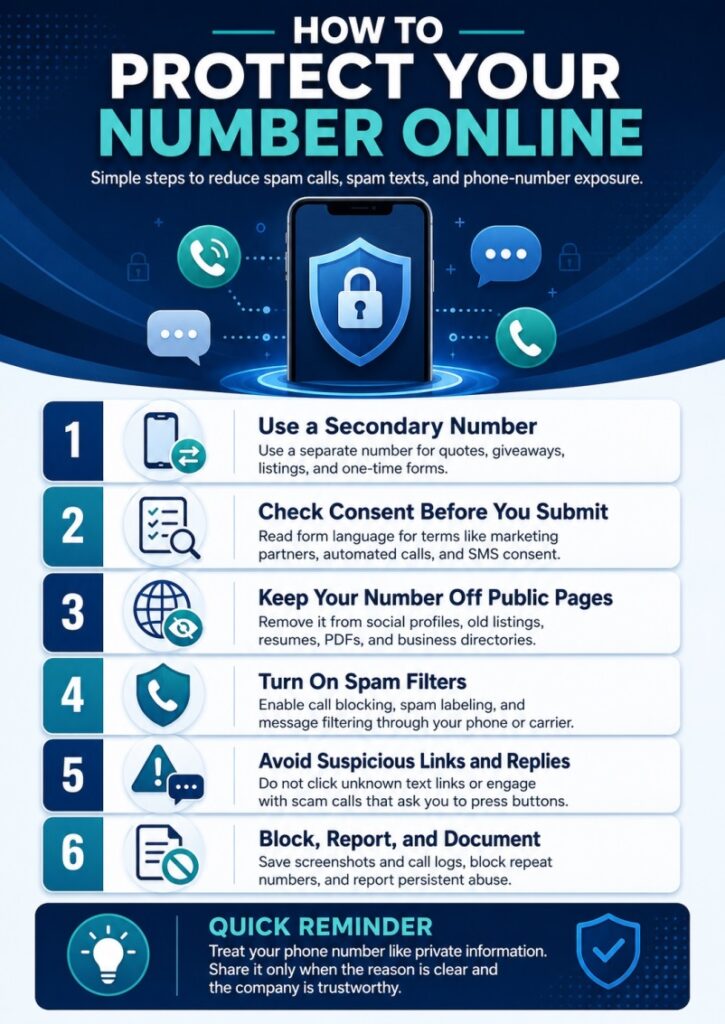
Treat your main phone number as private data. Do not enter it into every form that promises a free quote, free consultation, or fast estimate.
Use a secondary number for broad searches, marketplace listings, downloads, and one-time requests. Keep your primary number for banks, healthcare, work, family, and important accounts.
Before submitting any form, check whether the phone field is required. If it is optional, leave it blank.
If the field is required, read the consent language. Watch for terms such as automated calls, SMS consent, marketing partners, third-party providers, and not required for purchase.
Remove your number from public pages where possible. Check old resumes, PDFs, directories, social profiles, classified ads, review accounts, and forum bios.
Turn on carrier-level spam protection and phone-level filtering. These tools cannot stop every spoofed caller, but they reduce obvious robocalls and repeated nuisance patterns.
What to Do Once Your Number Is Exposed to Spammers
If someone entered your number into unwanted forms, stay controlled. Do not argue with every caller, press robocall buttons, or reply to suspicious messages.
Save call logs, screenshots, voicemails, message content, company names, dates, and times. Documentation is useful if the behavior continues.
Block repeat callers, learn how to report spam texts through your phone or carrier, and file complaints with relevant consumer-protection channels in your country.
If calls include threats, impersonation, account access attempts, or repeated verification codes, treat it as a security issue. Change passwords, review account recovery settings, and monitor sensitive accounts.
Also Read: How to See and Manage Blocked Numbers on iPhone
Why Free Telemarketing Signups Are a Warning Sign
Some searches around free telemarketing calls are tied to unsafe intent. Others come from people trying to understand how aggressive call lists work.
Either way, the practical lesson is the same: free lead forms often trade convenience for contact exposure. The offer may be free, but your number becomes the price.
A trustworthy company explains who will contact you, why they will contact you, and how you can opt out. A weak site hides that information or makes the submit button more visible than the consent terms.
This article is for privacy protection and consumer education only. It should not be used to harass, impersonate, threaten, or trigger unwanted calls or texts to any person.
Final Thoughts
Your number should be protected before spam systems reach it. Share it only when the reason is clear, the company is trustworthy, and the consent terms are readable. Use secondary numbers, remove public exposure, filter unknown traffic, and report abuse. A firm, lawful response protects you better than retaliation and keeps the problem from spreading across your daily life too.
FAQs
Why do spam calls continue after I block numbers?
Many callers rotate numbers or spoof caller ID. Blocking helps, but filtering, reporting, and reducing exposure work better together.
Should I use my real number for online quotes?
Use it only with trusted companies. For broad quote tools, a secondary number is safer.
Is it fair to sign someone up for spam calls?
It can create harassment, privacy, or consumer-protection problems. Do not do it; use lawful complaint channels instead.
